
Multimedia Journal of Metaverse in MEDICINE
RESEARCH ARTICLE | JANUARY 13, 2026
Integrating professional ethics and mental health education for undergraduate medical students—An exploratory nonrandomized study of two classes with four week follow up
Jingyuan Li¹, Xuelan Li¹, Hao Zhang², Yan Xue¹, Tuanhe Sun², Yu Liang¹, Wei Wang¹*
¹ Department of Obstetrics and Gynecology, The First Affiliated Hospital of Xi’an Jiaotong University, Xi’an, Shaanxi, 710061, China.
² Department of Surgical Oncology, The First Affiliated Hospital of Xi’an Jiaotong University, Xi’an, Shaanxi, 710061, China.
Corresponding Author: Wei Wang. E-mail: [email protected]
Address: Department of Obstetrics and Gynecology, The First Affiliated Hospital of Xi’an JiaoTong University, Xi’an, Shaanxi, 710061, China.
Abstract
Background: Integrating professional ethics with mental health education may connect clinical responsibilities with students’ understanding of distress and support. Evidence from small classroom studies requires attention to both design and measurement quality. Methods: Two classes from the 2024-entry undergraduate medical cohort at Xi’ an Jiaotong University received integrated teaching (n = 18) or usual Medical Ethics teaching (n = 16), delivered by the same teacher. Assessments were conducted before teaching, after the course, and four weeks later. Outcomes were case-based ethical reasoning and a project-developed 16-item mental health knowledge test, each scored 0–16. Two raters unaware of class allocation scored the assessments; case sets differed across time points. Exploratory baseline-adjusted comparisons were accompanied by change-score analyses and measurement checks. Results: Post-course mean ethical reasoning scores were 12.39 versus 10.57, and knowledge scores were 12.50 versus 10.44, in the integrated and control classes, respectively. Baseline-adjusted differences were 1.82 points (95% CI 0.14–3.49; Holm-adjusted P = 0.034) and 2.08 points (0.77–3.38; adjusted P = 0.0056). Change-score comparisons were inconclusive for both outcomes. Four-week means remained higher in the integrated class. Average-rating absolute-agreement intraclass correlations were 0.901, 0.838, and 0.756 across assessments; knowledge-test KR-20 coefficients were 0.225, 0.244, and 0.114. Conclusions: Higher post-course assessment scores were observed in the integrated class, with descriptive advantages at four weeks. One class per condition, sensitivity to analysis method, and weak knowledge-test internal consistency preclude conclusions about intervention efficacy or improved mental health.
Keywords: medical ethics; mental health education; undergraduate medical education; ethical reasoning; knowledge assessment; nonrandomized study
Introduction
Medical ethics teaching asks students to recognize competing responsibilities, understand patients’ perspectives, and justify decisions under uncertainty. These tasks also have emotional and interpersonal dimensions. A learner may identify a duty of confidentiality yet struggle to respond to a distressed patient or to recognize when personal distress warrants support. Professional education therefore needs to connect ethical reasoning with the knowledge required to respond appropriately to psychological difficulties. This connection is compatible with accounts of professional identity formation that place learning within the social and experiential context of becoming a physician [1].
Mental health literacy concerns the knowledge and beliefs that support recognition and appropriate responses to mental health problems [2]. It is related to, but distinct from, current mental health status. In a medical student curriculum, relevant educational targets include recognizing distress, avoiding stigmatizing assumptions, understanding help-seeking, and identifying everyday coping strategies. A digital curriculum evaluated by Kurki and colleagues reported changes in mental health knowledge and other outcomes, although the study used a single-group design and outcomes did not follow identical trajectories [3]. These findings support evaluating knowledge, wellbeing, and behavior separately rather than treating them as interchangeable indicators.
The present teaching reform originated within a Chinese curriculum-based values education framework that sought to connect professional responsibilities with psychological education. Its empirical focus was narrower than the broader policy framework: ethical reasoning in clinical cases and course-related mental health knowledge. Previous project work provided a rationale for integration, but a needs assessment cannot establish whether an implemented curriculum improves students’ performance. A comparison with usual teaching and a follow-up assessment can provide initial evidence while exposing limitations in the evaluation tools.
We examined two existing classes in a Medical Ethics course at Xi’an Jiaotong University. We asked whether the integrated class had higher post-course ethical reasoning and mental health knowledge scores than the usual-teaching class after accounting for baseline scores, and whether descriptive advantages were present four weeks later. We also examined interrater agreement and the internal consistency of the knowledge test. The study was designed and interpreted as an exploratory classroom comparison, not as a definitive efficacy trial.
Methods
1 Study design and participants
This was an exploratory, nonrandomized comparison of two existing classes from the 2024-entry undergraduate medical cohort at Xi’an Jiaotong University, China. The classes belonged to the same degree program and cohort. One class received the integrated teaching approach (18 students) and the other received usual Medical Ethics teaching (16 students). The same teacher taught both classes. Individual students were not randomly allocated to the teaching conditions. The two existing parallel classes from the same 2024-entry cohort were assigned to integrated versus usual teaching according to the pre-existing class structure; no individual randomization was performed.
Assessments were administered before teaching (T0), after the course (T1), and four weeks after course completion (T2). T1 was the principal comparison for the two main outcomes; T2 was used to describe short-term follow-up. The available dataset comprised the 34 enrolled students rather than a prospectively powered sample. No demographic or prior-attainment covariates were included in the supplied analytic data, and the two classes cannot be assumed exchangeable on the basis of similar baseline means.
2 Integrated and usual teaching
The integrated approach connected clinical ethical reasoning with psychological education within the Medical Ethics course. Informed by the project application, the teaching framework used case discussion, scenario-based exercises, and peer discussion or support to link professional responsibilities with recognition of distress, coping, and appropriate help-seeking. The intended educational connection was between understanding responsibilities toward patients and understanding the limits and support needs of oneself and others. It was not a psychological treatment program.
The clinical content provided opportunities to discuss autonomy, confidentiality, responses to distress, and the responsibilities and limits of a student’s role. Psychological education addressed recognition of difficulties, non-stigmatizing understanding, support and help-seeking, and everyday self-help strategies. The control class received the usual Medical Ethics course from the same teacher. Both classes received the same total contact hours from the same teacher. The integrated class used structured case discussions linking ethical dilemmas with recognition of distress, non-stigmatizing responses, and appropriate help-seeking; the usual-teaching class followed the standard Medical Ethics curriculum without the integrated psychological education component. Assessment conditions were identical. A reproducible description of the implemented teaching and comparator is important because content, interaction, attention, and integration may each contribute to observed differences [4].
3 Outcome measures
The first main outcome was a project-developed, case-based professional ethical reasoning assessment. Each assessment contained two clinical cases. For each case, raters scored identification of ethical issues, attention to the patient’s perspective and communication, justification and implementation of a decision, and recognition of responsibility boundaries and appropriate collaboration. Each criterion was rated 0, 1, or 2, giving each rater a total of 0–16. The outcome was the mean of two raters’ totals. The raters did not know the students’ class allocation. Different cases were used at T0, T1, and T2. Evidence that the three sets were equivalent in difficulty was not available, so case-set effects remain a possible influence on longitudinal change. The score reflects performance on the assessed cases rather than directly observed clinical conduct.
The second main outcome was a project-developed 16-item judgment test of course-related mental health knowledge. Items covered recognition and knowledge of psychological difficulties, non-stigmatizing understanding, knowledge of help-seeking and support, and self-help strategies. A correct answer received one point; an incorrect or uncertain answer received zero, giving a total of 0–16. The item data were already coded as correctness indicators, so no further reverse scoring was performed. The test was not the Mental Health Literacy Questionnaire–Short Version for Adults (MHLq-SVa). It did not measure depression, anxiety, wellbeing, observed help-seeking, or the ability to deliver professional psychological care.
4 Data integrity and missing values
Recorded rater totals were checked against their eight component ratings, averaged ethical reasoning scores against the two rater totals, and knowledge scores against all 16 item scores. All nonmissing totals in the final analysis file reconciled with their components. The dataset contained one record per student per time point. Missing assessments were retained as missing, without zero substitution, mean imputation, or last-observation-carried-forward replacement. Each comparison used students with the measurements required for that outcome and time point.
5 Statistical analysis
Analyses emphasized observed score distributions, differences in score units, and measurement limitations. Means, standard deviations, and available sample sizes were calculated separately by class, outcome, and assessment. For each outcome, post-course score was regressed on class condition and the corresponding baseline score. The same model was fitted separately for T2. Heteroscedasticity-consistent HC3 standard errors and t-based 95% confidence intervals were used. Baseline adjustment provides a comparison conditional on the measured starting score, rather than interpreting separate within-class significance tests as evidence of a between-class effect [5]. Holm adjustment was applied to the two T1 outcome comparisons. T2 and sensitivity analyses were exploratory, with unadjusted P values.
With only one class in each teaching condition, class and teaching condition were inseparable. A class random effect or cluster-robust standard error based on two classes would not resolve this design limitation [6]. Accordingly, the confidence intervals and P values reported here are conditional student-level model results for the observed classes, not valid class-level evidence of a causal intervention effect. HC3 addresses heteroscedasticity under the individual-error model; it does not correct shared classroom influences. The analysis was not represented as prospectively registered.
As complementary analyses, individual changes from T0 were compared between classes using Welch’s t tests. A leave-one-student-out check examined the influence of individual observations on the T1 baseline-adjusted estimates. These analyses were reported alongside the main models, including inconclusive results. No student or item was removed to improve statistical significance or internal consistency.
Interrater agreement was assessed separately at each time point using a two-way absolute-agreement intraclass correlation coefficient (ICC), reported for single ratings and for the mean of two ratings with 95% confidence intervals [7]. The numerical absolute-agreement estimates apply to the observed rating design; generalization to other raters remains limited. Criterion-level linear-weighted kappa values were examined descriptively. Knowledge-test internal consistency was calculated using KR-20 at each time point, with all students having a complete item set at that time. KR-20 was independently checked against the equivalent coefficient-alpha calculation for binary items. Correct-answer proportions and corrected item–total correlations were also examined. Repeated assessments were not pooled as 102 independent observations for reliability estimation. Analyses used Python with NumPy, pandas, SciPy, statsmodels, and Pingouin; library versions are provided in the analysis notes.
6 Ethics
Students were informed about the educational evaluation.
Results
1 Participants and score availability
All 34 students had baseline scores for both outcomes. Ethical reasoning scores were available for 18 integrated-class and 15 control-class students at T1, and 17 and 16 students, respectively, at T2. Knowledge scores were available for all students at T1 and for 17 integrated-class and 15 control-class students at T2. Four outcome assessments were missing across four students. These were outcome-specific missing values rather than evidence that all follow-up data were unavailable for those students.
Baseline mean ethical reasoning scores were 9.53 in the integrated class and 9.50 in the control class; corresponding knowledge scores were 8.50 and 8.31. Similar baseline score means did not establish equivalence of the classes. Descriptive results and outcome-specific denominators are presented in Table 1 and individual trajectories in Figure 1.
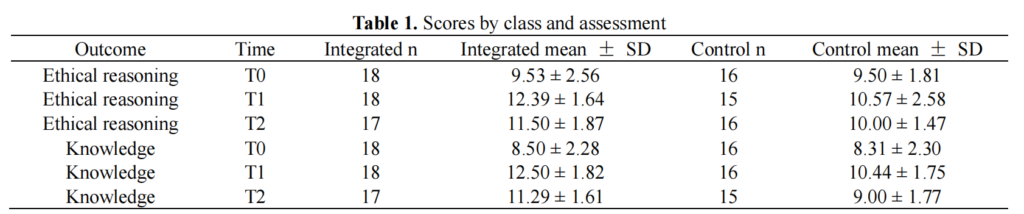
Note: Both outcomes range from 0 to 16. T0, baseline; T1, post-course; T2, four weeks after course completion. Counts are outcome-specific available cases. No missing value was imputed.
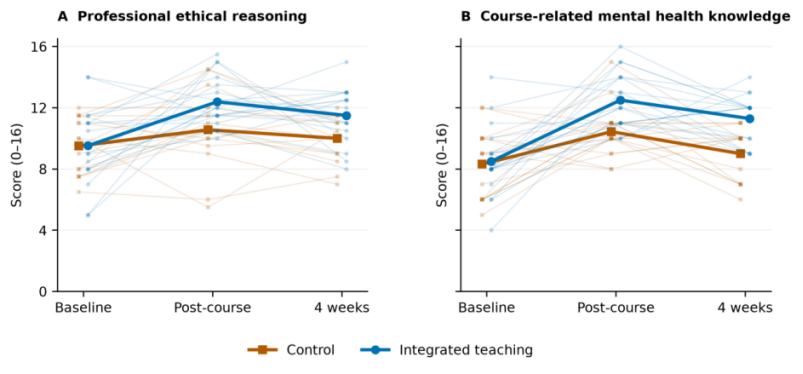
Fig.1 Individual and mean assessment trajectories
(Thin lines show individual students and thick lines show available-case class means. Missing measurements are not filled or bridged. The x-axis shows assessment occasions rather than equal calendar intervals. Small horizontal offsets separate the two classes visually. Both panels use the full 0–16 score range. No inferential error bars are shown because only one class represents each teaching condition. A, professional ethical reasoning; B, course-related mental health knowledge.)
2 Post-course and four-week comparisons
At T1, mean ethical reasoning scores were 12.39 in the integrated class and 10.57 in the control class. The baseline-adjusted difference was 1.82 points (95% CI 0.14–3.49; Holm-adjusted P = 0.034). Knowledge-test means were 12.50 and 10.44, with an adjusted difference of 2.08 points (95% CI 0.77–3.38; adjusted P = 0.0056). These estimates describe the separation between the two observed classes under the stated student-level model (Table 2).
At four weeks, the integrated class retained higher observed means for both outcomes. The baseline-adjusted differences were 1.52 points for ethical reasoning and 2.34 points for knowledge, with substantial uncertainty and the same class-confounding restriction as at T1 (Table 2). Among integrated-class students with all three ethical reasoning scores, the mean fell from 12.21 at T1 to 11.50 at T2 (n = 17). Among those with complete knowledge scores, the corresponding means were 12.53 and 11.29 (n = 17). Thus, the follow-up advantage did not indicate maintenance of the full post-course score gain.

Note: A, ethical reasoning; B, course-related knowledge. Difference = integrated minus control, adjusted for the corresponding baseline score. HC3 standard errors with t-based intervals. Holm adjustment applies only to the two T1 outcomes. T2 results are exploratory. All intervals and P values are conditional on a student-level model and do not resolve class–condition confounding.
3 Complementary analyses
Change-score comparisons provided weaker evidence than the baseline-adjusted post-course models. From T0 to T1, ethical reasoning increased by 2.86 points in the integrated class and 1.17 points in controls; the between-class change difference was 1.69 points (95% CI −0.46 to 3.85; P = 0.118). Knowledge increased by 4.00 and 2.13 points, respectively, giving a difference of 1.88 points (95% CI −0.27 to 4.02; P = 0.085). T0-to-T2 change comparisons were also inconclusive (Supplementary Table S1). The estimates therefore favored the integrated class in direction, but statistical interpretation depended on the analytic specification.
In the leave-one-student-out check, T1 adjusted ethical reasoning differences ranged from 1.45 to 2.11 points, with unadjusted P values ranging from 0.013 to 0.067. Knowledge differences ranged from 1.87 to 2.37 points, with P values from 0.0003 to 0.0054. The ethical reasoning comparison was therefore sensitive to individual observations around a conventional significance threshold; neither check removed the class-level confounding or established the validity of the knowledge score.
4 Measurement properties
For the mean of two raters, absolute-agreement ICCs were 0.901 at T0, 0.838 at T1, and 0.756 at T2 (Table 3). The corresponding single-rating estimates were lower, supporting the use of two-rater averages rather than assuming that one rating would provide equivalent precision. Agreement on individual criteria was less consistent: at T1, the decision-justification criterion in the second case had a linear-weighted kappa of 0.018. The total-score ICCs should therefore not be interpreted as uniform agreement on all components (Supplementary Table S3).
The knowledge test had low internal consistency: KR-20 was 0.225 at T0, 0.244 at T1, and 0.114 at T2. Corrected item–total correlations were nonpositive for 4, 6, and 8 items, respectively. Overall correct-answer proportions ranged from 41.2% to 67.6% at baseline, 61.8% to 82.4% after the course, and 50.0% to 84.4% at follow-up. The low coefficients were not attributable to universally perfect scores and do not support treating this test as a validated general mental health literacy scale. Item-level results are provided in Supplementary Table S2.

Note: ICCs use a two-way absolute-agreement definition. The mean-rating coefficient corresponds to the reported A outcome. KR-20 uses complete 16-item correctness records at each time point; repeated assessments were not treated as independent people. Low internal consistency restricts the interpretation of B.
Discussion
1 Principal findings
Students in the integrated Medical Ethics class had higher post-course assessment scores and higher observed means at four weeks than students in the usual-teaching class. This pattern provides an initial signal that connecting professional ethics with psychological education may be educationally useful. However, the signal is bounded by two findings that materially affect interpretation: class and teaching condition were completely confounded, and the knowledge test showed weak internal consistency. Inconclusive change-score comparisons further limit claims that the integrated approach produced greater improvement.
A plausible educational rationale is that ethical cases make psychological education relevant to responsibilities students already encounter in clinical learning. Respecting autonomy and confidentiality involves more than recalling principles; it also requires recognizing emotional responses, avoiding stigmatizing assumptions, and identifying when assistance is appropriate. Such links fit an understanding of professional learning as development in context [1]. This rationale remains an interpretation of the curriculum rather than a mechanism demonstrated by the present comparison. Additional attention, interaction, teacher expectations, or pre-existing class characteristics could also explain the observed score separation.
2 Position within the educational literature
The study complements curriculum-based mental health education by examining an ethics-related performance outcome alongside a knowledge test. Kurki and colleagues evaluated a digital program for first-year medical students and distinguished knowledge, stress, wellbeing, and help-seeking outcomes over time [3]. Our findings cannot be equated with improvements in those wider outcomes because we measured none of them directly. In particular, better answers about help-seeking do not establish that a student sought help, and higher ethical reasoning scores do not demonstrate improved clinical conduct.
The four-week assessment adds a short-term perspective to immediate post-course comparisons. Higher integrated-class means remained visible, but individual complete-case analyses showed a decline from post-course levels. This pattern is consistent with partial short-term retention rather than durable benefit. Whether reinforcement sessions improve retention would require a further comparison, with a sufficiently strong measurement strategy and more than one class per condition.
3 Implications of the measurement findings
The ethical reasoning assessment provides a more defensible outcome than a simple satisfaction rating because it requires students to articulate decisions in clinical situations. Two-rater averaging was supported by the absolute-agreement estimates. Nevertheless, disagreement on some individual criteria and the absence of demonstrated equivalence between case sets mean that the assessment should be treated as a developing curriculum instrument. Future use should include explicit scoring examples, rater calibration before scoring, documentation of independent ratings, and examination of case difficulty without rewriting prior observations.
The knowledge-test findings require particular caution. Knowledge tests may sample heterogeneous content, and low internal consistency is not synonymous with absence of all educational value. Research on domain-specific knowledge measurement shows that alpha depends on test length, content, population, and learning context [8]. That observation does not validate the present test: coefficients close to 0.1–0.2, together with several nonpositive corrected item–total correlations, leave substantial uncertainty about what its total score represents. The observed score difference can be reported as a course-test result, but it should not be promoted to a broad mental health literacy outcome.
A subsequent evaluation should establish content relevance and response processes before examining score relationships with an independently supported instrument. Published MHLq-SVa studies, including work involving Chinese students, offer a possible comparator for future validation rather than psychometric evidence transferable to this self-developed test [9,10]. Item revision should follow substantive review and independent testing; selecting or reversing items solely to maximize reliability in these 34 students would not provide credible validation.
4 Design limitations and next evaluation
The central design restriction is the lack of replication at the class level. The common teacher and shared entry cohort reduce some obvious differences but do not separate teaching effects from classroom influences. Neither baseline adjustment nor a low student-level P value can repair that confounding [6]. A stronger evaluation would involve multiple classes in each condition, with random allocation where feasible and an analysis that respects the allocation unit. If the aim is to isolate integration itself, comparison classes should receive comparable content and instructional attention in a separate format; otherwise the contrast remains the whole teaching package.
Other limitations narrow the findings further. Only two main outcomes were collected, demographic and prior-attainment information was unavailable for adjustment, and missing-outcome reasons were not documented in the analytic data. Different case sets may have differed in difficulty, whereas repeated knowledge items may have introduced familiarity. The four-week follow-up cannot establish long-term retention. No mental health symptoms, wellbeing measures, actual help-seeking, patient outcomes, or cost outcomes were assessed. Finally, the analyses were exploratory and individual-observation sensitivity was visible for ethical reasoning. The present results therefore identify priorities for a better controlled and better measured evaluation rather than establishing an effective or scalable educational model.
Conclusion
In two existing undergraduate Medical Ethics classes, integrated professional ethics and mental health teaching was associated with higher post-course ethical reasoning and course-test scores, with descriptive advantages at four weeks. The design does not support causal attribution, and the low internal consistency of the knowledge test restricts interpretation of that outcome. Replication across classes, fuller intervention documentation, and stronger measurement evidence are required before claims about educational efficacy or student mental health benefit are justified.
Author Contributions
Jingyuan Li wrote the first draft. Wei Wang contributed to the critical revision of the manuscript. Xuelan Li, Hao Zhang, Yan Xue, Tuanhe Sun and Yu Liang reviewed and revised the manuscript. All authors have read and agreed to the published version of the manuscript.
Funding
The work was supported by grants from The Undergraduate Medical Education Reform Research Project of Xi’an Jiaotong University Health Science Center (Grant No. 24JG003).
Conflicts of Interest
The authors declare no conflict of interest.
Data Availability Statement
The data that support the findings of this study are available from the corresponding author upon reasonable request.
Supporting information
Supplementary information for this article is available online at https://www.crossviwer.com/lijingyuan-article-supplementary/
Received: 26 October 2025
Accepted: 16 December 2025
Published on line: 13 January 2026
Reference
- Cruess RL, Cruess SR, Boudreau JD, Snell L, Steinert Y. Reframing medical education to support professional identity formation. Acad Med. 2014;89(11):1446–1451.
- Jorm AF, Korten AE, Jacomb PA, Christensen H, Rodgers B, Pollitt P. “Mental health literacy”: a survey of the public’s ability to recognise mental disorders and their beliefs about the effectiveness of treatment. Med J Aust. 1997;166(4):182–186.
- Kurki M, Gilbert S, Mishina K, et al. Digital mental health literacy -program for the first-year medical students’ wellbeing: a one group quasi-experimental study. BMC Med Educ. 2021;21:563.
- Hoffmann TC, Glasziou PP, Boutron I, et al. Better reporting of interventions: template for intervention description and replication (TIDieR) checklist and guide. BMJ. 2014;348:g1687.
- Vickers AJ, Altman DG. Analysing controlled trials with baseline and follow up measurements. BMJ. 2001;323(7321):1123–1124.
- Campbell MK, Piaggio G, Elbourne DR, Altman DG; CONSORT Group. Consort 2010 statement: extension to cluster randomised trials. BMJ. 2012;345:e5661.
- Koo TK, Li MY. A guideline of selecting and reporting intraclass correlation coefficients for reliability research. J Chiropr Med. 2016;15(2):155–163.
- Edelsbrunner PA, Simonsmeier BA, Schneider M. The Cronbach’s alpha of domain-specific knowledge tests before and after learning: a meta-analysis of published studies. Educ Psychol Rev. 2025;37:4.
- Campos L, Dias P, Costa M, et al. Mental health literacy questionnaire-short version for adults (MHLq-SVa): validation study in China, India, Indonesia, Portugal, Thailand, and the United States. BMC Psychiatry. 2022;22:713.
- Su D, Liao J, Chen J, Peng K. Reliability and validity of Mental Health Literacy Questionnaire-Short Version for Adults in Chinese college students. Chinese Journal of Clinical Psychology. 2024;32(6):1357–1361.
- Kassis T, Agarwal V, He Y, Patel D, Brueckner AM. Scientific Agent Skills: A Library of Procedural Knowledge for Research Agents. arXiv. 2026.